SUSTAINABLE DEVELOPMENT GOALS
SDG 16: PEACE, JUSTICE, AND STRONG INSTITUTIONS
“SDG 16 and 17 explore some of the underlying factors that are needed in order to ensure delivery of the other SDGs. Peace and Justice go hand in hand – and indeed are vital for equity between people and countries. Supporting this we need our institutions to be strong enough to maintain a focus on delivering the SDGs. This can range from individual justice – eradicating modern slavery and people trafficking – to ensuring that our countries have the evidence base needed to react appropriately to crises.”
(THE Impact Rankings)
University governance measures
Elected representation
Students’ union
Identify and engage with local stakeholders
Participatory bodies for stakeholder engagement
University principles on corruption and bribery
Academic freedom policy
Publish financial data
Elected representation
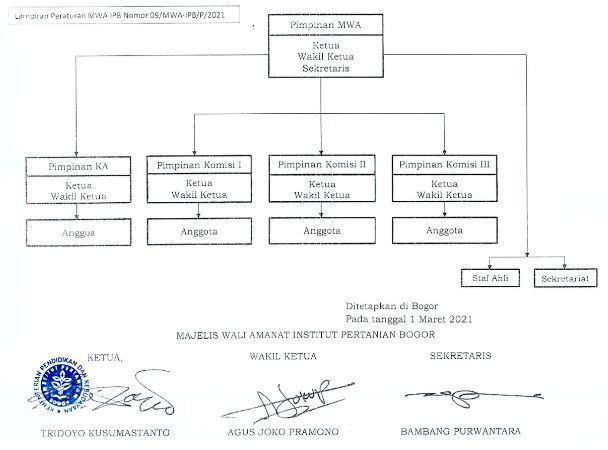
IPB University has elective representation (the Board of Trustees), namely Majelis Wali Amanat (MWA), the highest body at the university. According to the MWA Decree of IPB University no. 09/WMA-IPB/P/2021 concerning organizational structure and governance, MWA has 17 members consisting of representatives of various stakeholders, including the Ministry of Education, the Rector, the Academic Senate representing faculty members (8 people), the chief of staff organization, the president of the student organization, the chief of the alumni association, and representation of society (4 people) (p. 78).
<<Board of Trustee’s Organizational Strucuture>>
Every year, IPB holds an annual meeting by the Board of Trustees to discuss policy and annual performance report.
<<IPB Sustainability Report 2022: SDG 16 – p.78-81>>
Students’ union
IPB University has 119 student organizations as a forum for students in democratic learning related to the academic environment, student affairs, etc. Each faculty, department, and the university has a students’ union consisting of the Student Consultative Assembly (MPM), the Student Representative Council (DPM), the Student Executive Board (BEM), the Undergraduate Students’ Professional Association, the Vocational Professional Association, Student Activity Units (UKM), and Postgraduate Student Community (Forum Wacana). Students’ union is regulated in the Rector’s Regulation No.19/IT3/KM/2018.
<<Recognition of IPB Students’ Union>>
<<Recognition of the head of the students organization>>
<<IPB Sustainability Report (page 78)>>
Identify and engage with local stakeholders
IPB University formulated policies and procedures to identify stakeholders and aims to build strong engagement with them, as written in IPB Statute Articles 38-39, which specify collaboration in academic and non-academic affairs. In more detail, this collaboration is regulated through MWA Regulation No. 11/IT3.MWA/PR/2018 concerning non-academic collaboration (Kerjasama Non-Akademik). Through this policy, IPB specifies the scope of non-academic collaboration, establishes the criteria for partner candidates that must be assessed, and specifies the implementation procedure.
All evidence of activities and specific guidelines to identify and engage with local stakeholders falls under the Directorate of Community Development at IPB University.
<<IPB Statute>>
<<IPB Sustainability Report 2022, p. 78>>
Participatory bodies for stakeholder engagement
IPB University ensures that local stakeholders in the university, including residents, local government, and civil society representatives, have a meaningful mechanism for university decision-making. The engagement of stakeholders is manifested in the structure of the Board of the Trustees IPB University, such as Lecturer Representatives, Community Representatives, and Student Representatives.
Local stakeholders, including local government and civil society, are important elements of the Board of Trustees of IPB University, who participate in the university’s decision-making. There are four representatives of society who take part in the Board of Trustees of IPB University, including:
- Mochamad Ridwan Kamil (Governor of West Java Province)
- Suryopratomo (element of society)
- Sunarso (element of society)
- Agus Joko Pramono (element of society)
All evidence of activities and specific guidelines to identify and engage with local stakeholders under the Directorate of Community Development IPB University.
IPB also actively engages with the local government in Bogor. For example, since 2021, IPB University and the Local Government of Bogor launched Sekolah Pemerintahan Desa to implement good governance at the local level and to help village apparatus to do their job more optimally.
<<Launching School for Rural Governor>>
University principles on corruption and bribery
IPB University has principles and commitments on anti-organized crime, anti-corruption, and bribery as stated in our Senate Academic Regulation No. 33/SA-IPB/P/2019, article 1 point m, page 3, and article 11, p. 9–10, “Pencegahan Kejahatan Luar Biasa”. In its efforts to combat corruption, IPB collaborates with the Corruption Eradication Commission (KPK). <<see more>>
IPB University formed an Anti-Corruption Working Group as stated in Rector’s Decree No.122 Year 2023 about assignment of anti-corruption working team personnel bogor agricultural institute in 2023. <<see more>>
In 2022, IPB University became the first and only university to implement a pilot project about anti-corruption education from Indonesia’s Corruption Eradication Commission (KPK). This project aims not only to educate the students and staff but also to build a strong anti-corruption environment on the campus. <<see more>>
Academic freedom policy
IPB has a policy to support academic freedom through Academic Senate Regulation No. 28/SA-IPB/P/2018 concerning Norms, Academic Freedom, and Scientific Autonomy. Article 4 point 2 specifies the scope of academic freedom, including teaching, research, and community empowerment. This regulation is valid for all faculty members, regardless of their ages, as well as staff and students. Article 4 point 3 specifies various areas or forums in which academic freedom is ensured and respected.
Publish financial data
IPB University committed to publishing its financial report annually. The annual financial report is publicly opened and audited by an independent auditor, namely PwC. The opinion of the public accountant on the IPB Financial Report 2022 can be seen on Page 4. It is written that the consolidated financial performance and cash flow in 2022 are under the Indonesian Financial Accounting Standards
<<IPB Financial Report 2022 (Audited)>>
<<IPB Financial Report 2016-2021 (Audited)>>
<<Standard Operational Procedure (SOP) of IPB Financial Management>>
Working with government
Provide expert advice to government
Policy and lawmakers outreach and education
Participation in government research
Neutral platform to discuss issues
Provide expert advice to government
IPB University actively provides advice and inputs for policy-making made by the local, regional, and national governments in agriculture, marine, and biosciences. The following are several examples of expert advice delivered to regional and national governments in 2022. Specific expert advice for the national government:
A. Specific Expert Advice to the National Government
- IPB University helps and gives recommendations to prevent and treat foot and mouth disease (Penyakit Mulut dan Kuku (PMK)) to the national government. IPB encourages the government to conduct a public-private partnership to overcome foot and mouth disease (FMD). This recommendation attempts to include all parties, especially the industry, in jointly combating FMD.
<<see the detail>> - The IPB University Board of Professors provides policy recommendations to anticipate food price spikes for 3 commodities (cooking oil, soybean, and beef). IPB University professors recommend the government provide a quick response to ensure the public can reach the price of cooking oil. The professors also recommend that the target import-to-domestic soybean production ratio be established by the government and then included in a flowchart to achieve higher production.
<<see the details>> - Experts from IPB University recommend the tobacco products excise policy to the House of Representatives State Financial Accountability Board. An IPB University professor explained that tobacco is one of the agricultural products with high biomass, so other products besides cigarettes can be created.
<<see the details>>
B. Specific expert advice to regional government
- IPB University Gives Alternatives Reservoir Management in DKI Jakarta <<see the details>>
- IPB Recommends a management and monitoring model for the high conservation value and high carbon
<<see the details>>
C. Specific expert advice to local government
- SDGs Regional Action Plan with the Tangerang Regency Bappeda
<<see the details>> - Strategic Environmental Assessment (KLHS): Master Plan for Sustainable Plantation 2022–2040 at Sintang District, West Kalimantan Province (p. 4–5) <<see the details>>
IPB also actively provides policy briefs for the local, regional, and national governments, which were published in Policy Brief Pertanian, Kelautan, and Biosains Tropika.
<<Policy Brief Pertanian, Kelautan, dan Biosains Tropika>>
Policy and lawmakers outreach and education
IPB University maintains activities for providing general education, upskilling, and capacity-building for policymakers at various levels in agriculture, marine, and biosciences:
- Regular training of Biodiversity (flora and fauna) with High Conservation Value (HCV) <<see the details>>
- Village Government School <<see the details>>
- Training on Preparing Regional Government Expenditure Analysis
<<see the details>> - Training on BRC Global Standard for Food Safety Issue 9
<<see the details>> - BNSP Certification and HACCP Drafting <<see the details>>
- Hydrobiology Professional Training <<see the details>>
Participation in government research
IPB University undertakes policy-focused research in collaboration with government departments. Some of these activities include collaboration with the local government and national government, such as:
- The study of the Key Performance Indicator (KPI) for the National Initiative for Sustainable and Climate-Smart Oil Palm Smallholders was conducted by CCROM IPB University in collaboration with the Indonesia Oil Palm Research Institute and the Ministry of Agriculture (p. 3–4).
<<see the details>> - The study of the sustainable utilization of the Marine Conservation Area of Sawu Sea by the Community in collaboration with The Ministry of National Development Planning under the consortium program of the Coral Reef Rehabilitation and Management Program—Coral Triangle Initiative (CORE MAP-CTI). <<see the details>>
- The study on seed development policy was conducted in collaboration with the Ministry of Agriculture. <<see the details>>
Neutral platform to discuss issues
IPB Strategic Talks is a neutral platform and safe space for political stakeholders to discuss challenges. Various topics on policies related to agriculture, marine, and biosciences have been discussed among various stakeholders, including academicians, the government, and political stakeholders. IPB Strategic Talks are organized regularly by the Directorate of Scientific Studies and Academic Reputation.
<<Strategic Talks: Neutral Platform to Discuss Issues>>
SDG 16 IN NUMBER
7,400
Number of graduates in most recent year
343
Number of graduates from Law
4.6 %
Percentage of graduates from Law
Select an image for which you want to see the achievement of the SDG indicators

RELATED NEWS
It seems we can’t find what you’re looking for.