SUSTAINABLE DEVELOPMENT GOALS
SDG 7: AFFORDABLE AND CLEAN ENERGY
“After water and food, energy is one of the key enablers of human life. Energy is central to nearly every major challenge and opportunity the world faces today and access to energy for all is essential. But energy needs to be available and affordable to all to allow future development, and it needs to be clean in order to ensure that the development can be sustainable.”
(THE Impact Rankings)
University measures towards affordable and clean energy
Energy-efficient renovation and building
Upgrade buildings to higher energy efficiency
Carbon reduction and emission reduction process
Plan to reduce energy consumption
Energy wastage identification
Divestment policy
Energy-efficient renovation and building
IPB University has a policy to ensure all renovations or new builds follow energy efficiency standards. As mentioned in the IPB Green Campus Academic Paper (page 31, 43, 60), IPB University integrates green building components into all renovation and construction strategies to achieve efficient and low-carbon energy consumption. In addition, IPB Green Campus Academic Paper also contains the energy efficiency standard (Chapter 5.5 page 82-86 and Chapter 6.4 page 115-117) and Infrastructure and Green Building (Chapter 5.6 page 87-89).
IPB declared its commitment to:
- Implementing green building components in all IPB buildings and infrastructure
- Monitoring energy efficiency and overall electricity use, as well as encouraging the use of renewable energy sources in all IPB buildings and infrastructure.
- Renovate existing buildings to meet green building standards, focusing on energy efficiency.
IPB Green Campus Academic Paper
IPB University Commitment to Achieve Carbon Neutrality in 2030
IPB University created a green building master plan for integrated area development to achieve green campus criteria. The criteria of Green Campus IPB is written in IPB Rector’s Decree No 104/IT3/LK/2019.
IPB University Green Campus Criteria
Upgrade buildings to higher energy efficiency
In the Academic Paper and Planning for IPB Green Campus Implementation 2019-2023, IPB University has planned to evaluate and upgrade the existing buildings to higher energy efficiency (Chapter 6.4 and 6.5 page 115-120).
IPB University Green Campus Academic Paper
To achieve the targets, especially related to green building and energy efficiency, since 2019, IPB University cooperates with Green Building Council Indonesia (GBCI) by signing a Memorandum of Understanding (MoU). By this cooperation, IPB University is ensuring the fulfillment of its Green Campus commitment, particularly to follow energy efficiency standards on its old and new buildings and infrastructures. In addition, IPB and GBCI are also committed to collaborating in education, research, and community service in the context of developing green buildings in Indonesia.
IPB Commitment to Achieve Carbon Neutrality in 2030
Carbon reduction and emission reduction process
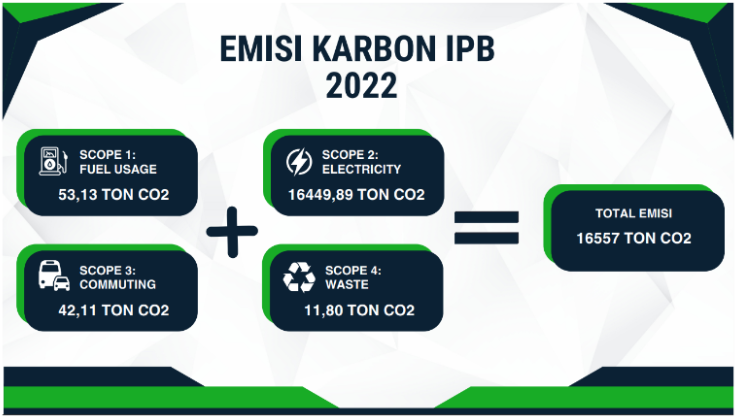
Since 2019, IPB has conducted a Carbon Footprint (CFP) study as an effort to reduce carbon dioxide emissions. The results of this study are used as one of the important consideration in the determination of Carbon Management in the IPB campus environment.
IPB Carbon Footprint Report 2019
IPB Carbon Footprint Report 2022
IPB University continues to implement a program to reduce CO2 emission through 4 elements of green campus, those are: i) green transportation, ii) green movement, iii) green energy, and iv) dan green building/open space (Page 4; 115-117). The Guidelines for implementing carbon management and reducing CO2 gas emissions are documented in the IPB towards Green Campus Academic Paper.
IPB University Green Campus Academic Paper
IPB University realizes the importance of green transportation, since it will play an essential role in reducing the level of pollutants and carbon emissions in the campus environment. Transportation policies to limit the number of motorized vehicles, use of campus buses & bicycles will encourage creating a healthier environment.
Plan to reduce energy consumption
IPB University has an energy efficiency and low carbon emission plan through the Green Campus Academic Paper. IPB is committed to developing green energy sources. Green energy is carried out by reducing electrical energy from fossil fuels (including PLN) and replacing it with solar energy, hydropower (MHPP), biogas and biomass. IPB’s energy efficiency plan is stated in Green Campus Academic Paper (page 116-117).
IPB University Green Campus Academic Paper
To achieve energy efficiency and low carbon emissions, IPB has several programs:
- Developing micro-hydro installations
- Identify energy-saving lamp types
- Identify priority buildings (pilot projects) that use energy-saving lamps
- Installation of lighting sensors in closed and open spaces
- Campaigns and education on energy conservation
- Measure vehicle emissions
In addition, the IPB University Strategic Plan also formally states the energy efficiency commitment. IPB is committed to reducing energy consumption through various research activities and innovations related to biomass and bioenergy, wind energy, and biogas. IPB University created a green building master plan for integrated area development to achieve green campus criteria.
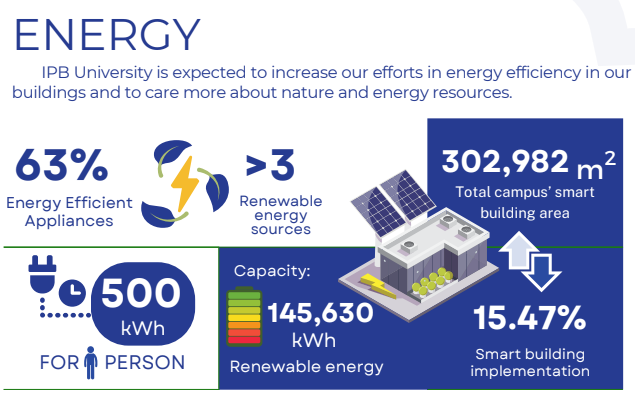
Energy Efficiency in IPB University (page 8)
Energy wastage identification
IPB University regularly undergoes energy reviews to identify areas where energy wastage is higher. Since 2019, IPB has conducted a Carbon Footprint (CFP) study to reduce carbon dioxide emissions. One of the results of this study shows the areas where energy wastage is highest (page 16-17).
IPB Carbon Footprint Report 2019
IPB Carbon Footprint Report 2022
Divestment policy
IPB University has a policy on divesting investments from carbon-intensive energy industries by developing some technologies to reduce coal waste and oil usage. Since 2019, IPB is fully committed to realizing a green campus by using the green campus movement, such as using renewable energy such as solar panels, biogas, and electric cars. The IPB’s commitment to the use and development of renewable energy in the IPB campus environment is stated in the IPB Green Campus Academic Paper 2019-2023. Many innovations use systems based on renewable energy, are environmentally friendly, and do not depend on carbon-intensive energy.
IPB University Green Campus Academic Paper
IPB Innovations: Energy Series
Solar Panel
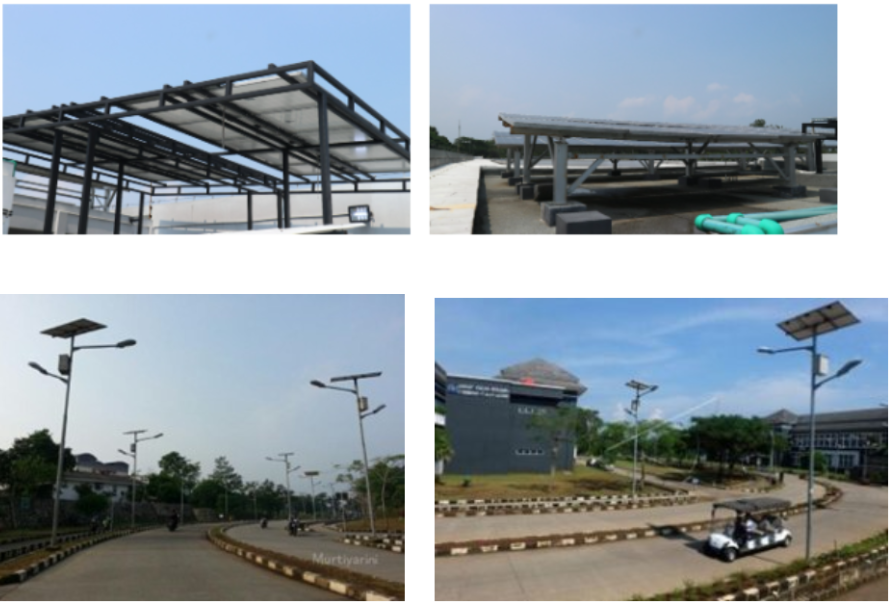
Electric Cars
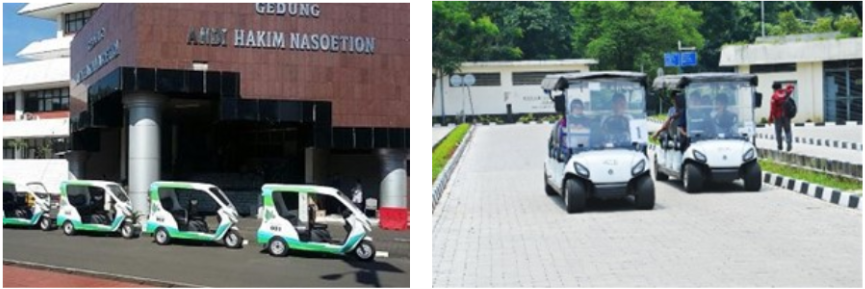
IPB University is committed to realizing a green campus through the Decree of the Rector of the Bogor Agricultural University Number 104/IT3/LK/2019 regarding the criteria for IPB green campus. The criteria for IPB green campus are as follows:
- Compliance with environmental regulations
- Water-sensitive management
- Enhancement and protection of biodiversity and sustainable landscapes
- Energy efficiency and climate
- Green infrastructure and buildings
- Green transportation dan
- Integrated and sustainable waste management
IPB University Green Campus Criteria
Energy and the community
Local community outreach for energy efficiency
100% renewable energy pledge
Energy efficiency services for industry
Policy development for clean energy tech
Assistance to low-carbon innovation
Local community outreach for energy efficiency
IPB University provides various programs for local communities related to energy efficiency and clean energy.
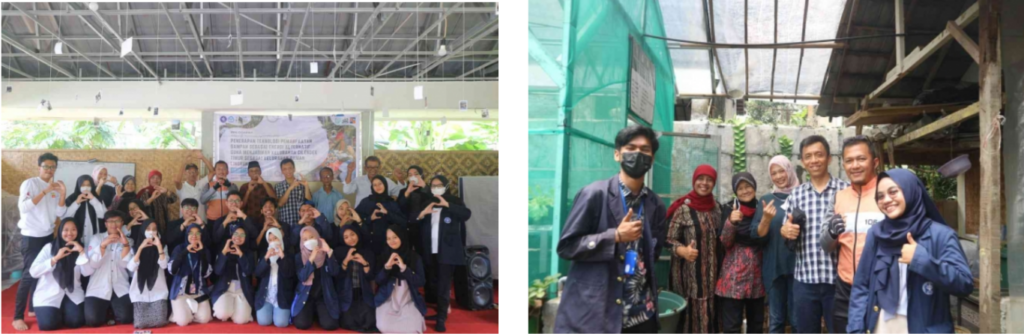
IPB University Students Educate The Community about Renewable Energy from Waste
IPB University students carried out a program to educate the community in Cilendek Timur Village to process waste into renewable energy. The teaching materials include processing plastic waste using pyrolysis, making briquettes, composting, cultivating maggots, and making biopore absorption holes.
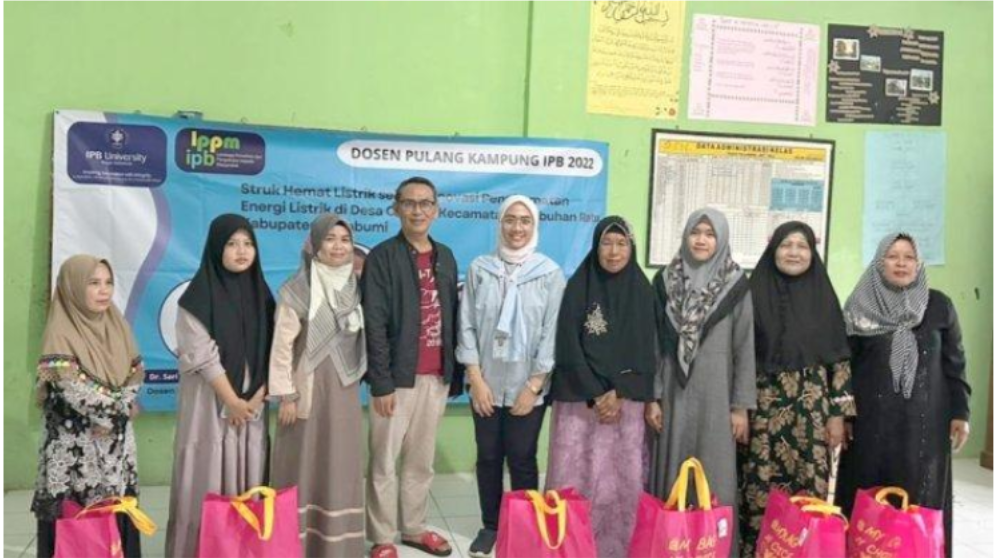
IPB’s Lecturers Socialized The “Energy Efficient Receipt” to The Community in Cikadu Village
IPB’s lecturers socialized the “energy efficient receipt” to the community to help them lower their electricity bill. “Energy Efficient Receipt” is one of the IPB lecturers’ inovation. This Energy Efficient Receipt is a colored household electricity bill showing total electrical energy usage per kWh per month that was created using a combination of behavioral economics, electrical energy efficiency, self-control, and sustainable development concepts.
IGAF IPB held Earth Hour Webinar: One Hour to Know about Unity in Biodiversity to Saving Our Earth. This program aims to give awareness for the community to increase environmental concern as well as to reduce global warming effects and balance energy usage in daily life.
100% renewable energy pledge
IPB promotes a public pledge toward 100% renewable energy. Here are some of the activities:
The 7th International Seminar on Natural Resources and Environmental Management
IPB University is holding a webinar related to renewable energy. This webinar discussed the prospects for biomass stoves as an alternative energy source for households and small industries in the New Normal Era. IPB University will continue striving to produce research about biomass and biofuel-based alternative energy. IPB University also organizes meetings on The 7th International Seminar on Natural Resources and Environmental Management from August 1-2, 2022, to discuss bioenergy utilization strategies and commitment to promote 100% renewable energy.
International Conference of Biomass and Bioenergy (ICBB)
During the International Conference of Biomass and Bioenergy (ICBB) held by the IPB Surfactant Bioenergy Research Center (SBRC), Institute of Research and Community Service (LPPM) IPB University in Baranangsiang Campus, Bogor, the Rector of IPB University, Dr Arif Satria said that IPB University will keep on striving to produce researches about biomass and biofuel-based alternative energies.
Energy efficiency services for industry
IPB University and BPDPKS Held International Conference on Biomass and Bioenergy
IPB provides direct services to local industry, which aims to increase energy efficiency and develop biomass and bioenergy to achieve net zero emissions. This activity is in collaboration with the Palm Oil Plantation Fund Management Agency (BPDPKS). Prof. Dr. Arif Satria, Rector of IPB University, stated that the significant number of biological resources, both in quantity and diversity, has the potential to be used as bioenergy. Indonesia has vast potential biomass sources, including agricultural and plantation products, forest products, and marine biomass, which may be utilized for producing diverse bioenergy products and high-value biomaterials that can help achieve sustainable development goals.
SBRC IPB and Pertamina Develops Seaweed-Based Biogas
Through the Surfactant and Bioenergy Research Center (SBRC), IPB University receives services for research and non-research activities on surfactant, biomass and bioenergy, biomaterials, management and business (free and paid). SBRC IPB also supports practical laboratory, open for final year students to conduct research projects or join in an internship program.
Policy development for clean energy tech
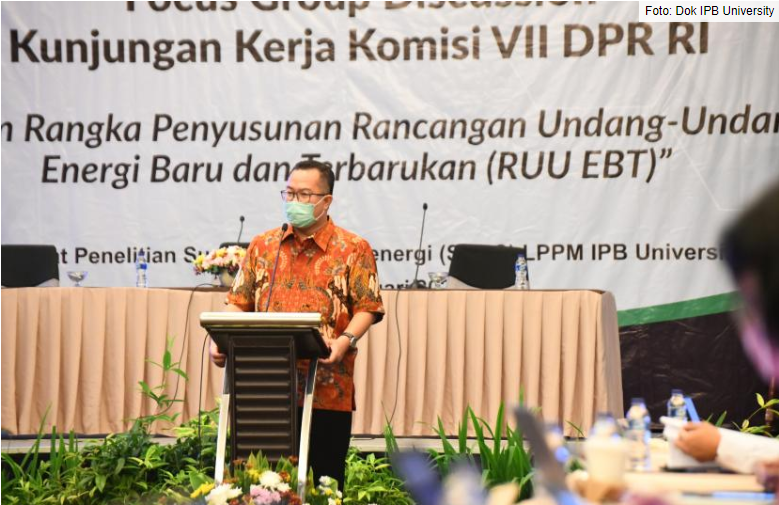
IPB actively informs and supports the government in clean energy and energy-efficient technology policy development. At national level, DPR (The House of Representative of Republic of Indonesia) asked for advices from IPB University regarding the Draft Bill of Clean & Renewable Energy Policy.
IPB University Gives Advice for The House of Representative
Assistance to low-carbon innovation
IPB University provides service assistance for startups operating in the field of economics or low-carbon energy technology. The Science Techno Park Institute (STP IPB) is professionally managed to develop innovation, business incubation, and technology transfer to develop and encourage sustainable economic growth. STP IPB supports starting from developing innovation. One of the main focuses of STP IPB is in the development of innovations in the energy sector, such as carburetors for biogas fuel, wind power coolers, and environmentally friendly street lights.
IPB provides buildings for startup incubation, namely the Startup Center (GSC) Building of the Regional Institute of Science and Technology (LKST). IPB University is now ready to accept business incubation program tenants.
SDG 7 IN NUMBER
64,205 GJ
Total energy consumption
306,104 m²
University floor space
0.21 GJ
Total energy consumption per sqm
Select an image for which you want to see the achievement of the SDG indicators
RELATED NEWS
It seems we can’t find what you’re looking for.