SUSTAINABLE DEVELOPMENT GOALS
SDG 2 : ZERO HUNGER
“The ability to feed the world is a key element of sustainable development. If done right, agriculture, forestry and fisheries can provide nutritious food for all. At the same time it can ensure rural development with people at the centre of the process, supporting the incomes of those who rely on agriculture. Universities need to be able to demonstrate how they are contributing to end hunger, achieve food security and improved nutrition and promote sustainable agriculture.”
(THE Impact Rankings)
Campus Food Waste
Campus Food Waste Tracking
Campus Food Waste Tracking
IPB University is committed to reducing food waste from the campus population. To minimize food waste, IPB University also mandates all units within the campus to manage and measure their waste. This mandate is stated in the Circular Letter on Waste Management at IPB University. This mandate indicates IPB University’s commitment to reducing food waste in every possible way.
<<Circular Letter on Waste Management>>
As a campus that cares about the cleanliness of waste in its environment, IPB University has the concept of 3R waste management hierarchy (reuse, reduce, recycle). This is in accordance with the basic foundation of the campus in waste management through Rector Decree No. 29/IT3/OT/2020.
<<Rector Decree No. 29/IT3/OT/2020 – about Waste Management>>
In addition, in showing its commitment to reducing waste, IPB University also implements a ‘zero waste policy’ which means management without residue by mandating that all work units in the campus environment carry out waste management and measurement.
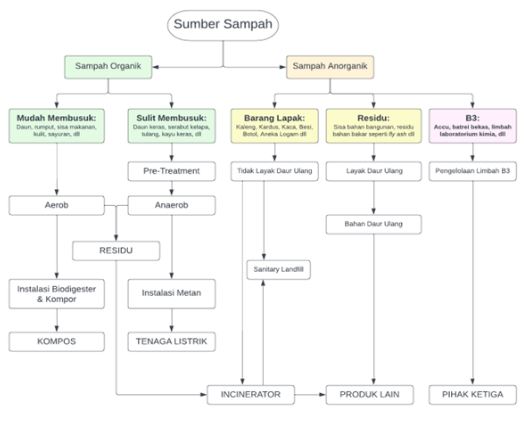
Since 2019, the management and measurement of IPB campus waste have used a method that refers to SNI 19-3964-1994 regarding Methods for collecting and measuring samples of urban waste generation and composition. The procedure is as follows:
- Food waste that was collected from each station was weighed with digital scales with an accuracy of 1 gram.
- Food waste was sorted according to food waste components: rice, vegetables, and dishes.
- Each component of food waste was weighed.
- The weighted food waste was recorded on the tally sheet
Sustainable waste management steps in the university’s environment are expected to be able to overcome types of organic and inorganic waste.
<<SNI 19-3964-1994 – Methods for collection and measurement of waste>>
Members of the university can help reduce those numbers by ordering food mindfully for any event organized on campus. For University catered events, it is important to ensure accurate numbers. If there is a change in numbers, then informing the catering staff of this can help reduce the amount of food waste. The university also has a list of approved charities that collect leftover food from events and meetings.
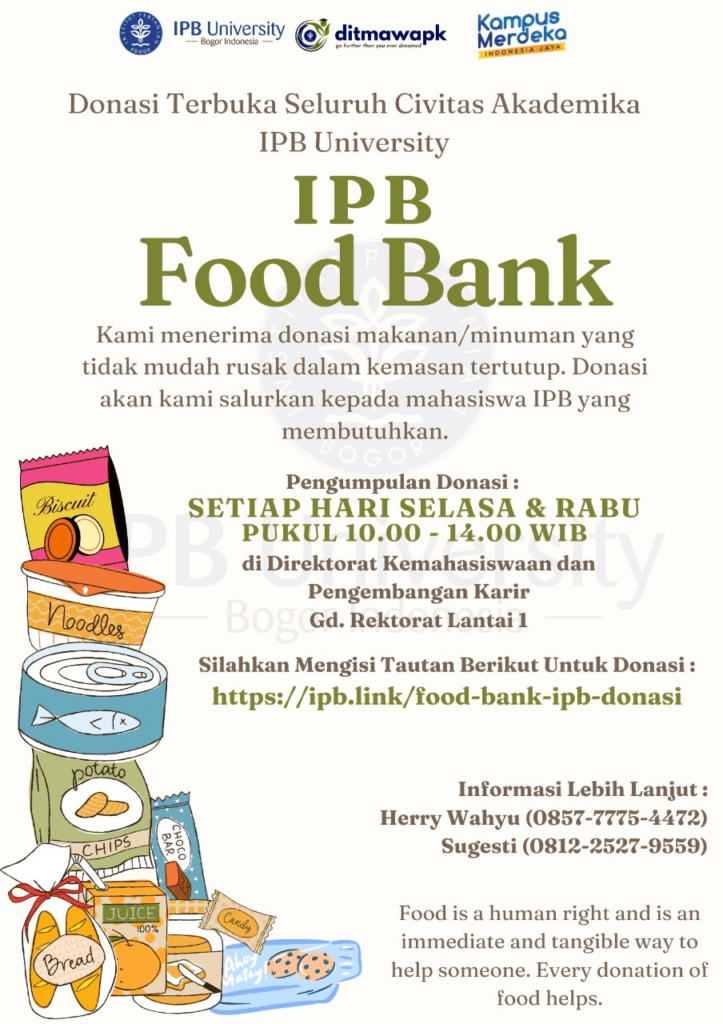
<<IPB Food Bank>>
<<Policy Brief on Food Waste>>
Student Hunger
Student food insecurity and hunger
Students and staff hunger interventions
Sustainable food choices on campus
Healthy and affordable food choices
Student food insecurity and hunger
IPB University has several programs in place to address student food insecurity and hunger. Programs conducted in 2022 include:
- IPB Food Bank. IPB provides intervention to prevent hunger among students and staff. We called it the IPB Foodbank. The IPB Foodbank is held every Friday from 13.00 to 14.00. Food packs for students and staff contain biscuits, cookies, instant noodles, etc. The number of food packs is 75 per day. <<see the details>>
- IPB Go Maksi (Free Lunch program for undergraduate students): Go Maksi is a free lunch program for needy students. Every week, Agrianita provides 350 Go Maksi (lunch subsidy) coupons for ten dormitories. This coupon can be used at IPB’s canteen, such as a Green corner, Red corner, Purple corner, Blue corner, and Mandala canteen. This program collaborates with any partners that have empathy for others to improve students’ welfare. <<see the details>>
- Dapur Agrianita (Agrianita’s Kitchen) Every month, Agrianita IPB provides a free meal for more than a thousand students in IPB. The mechanism of implementation will be the rotation of faculties. Ideally, Agrianita’s kitchen targets to provide at least 200 portions of healthy and affordable food every day. Dapur Agrianita holds a healthy eating event at least once a month. <<see the details>>
- Milk and Fruits Assistance. This program was organized by the Directorate of Student Affairs at IPB University to provide free milk and fruits for undergraduate students. <<see the details>>
Students and staff hunger interventions
IPB provides intervention to prevent hunger among students and staff through the food bank. This intervention is implemented under the coordination of the Directorate of Student Affairs and Career Development. The IPB Food Bank is held every Friday from 13.00 to 14.00. Food packs are available for students and staff. There are varieties of food that are provided, among others: bread, biscuits, cookies, noodles, etc. The number of food packs distributed is 75 per day. The Directorate of Student Affairs and Career Development continues to raise donations from the campus population to provide more food and increase the number of foodbank beneficiaries.
<<The IPB Food Bank>>
<<Free Water Drinking Station for All>>
Sustainable food choices on campus
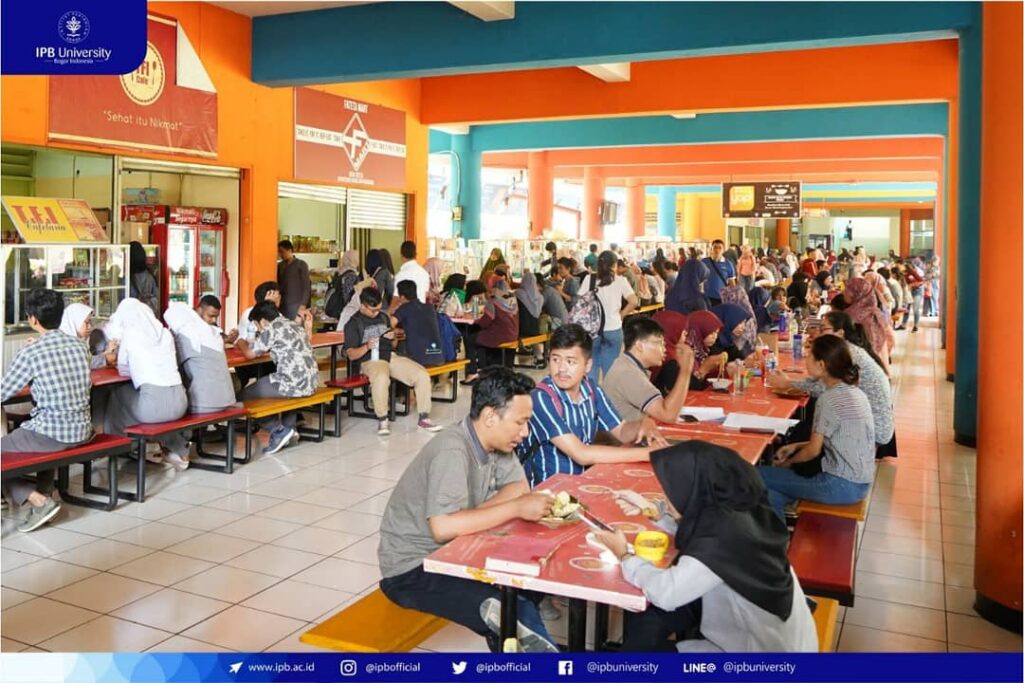
IPB provides sustainable, healthy, and affordable food choices for all on campus. Examples of student’s favorite canteens are Sapta, Yellow Corner, Blue Corner, and Purple Corner, which provide menus for campus students and people who are vegan or vegetarian to be able to consume types of food that are tolerant of them.
<<Sustainable, Healthy, and Affordable food choices on campus>>
Almost all the food provided in the IPB canteen is sold at a very friendly and affordable price. Healthy food can be seen in menu options that balance nutrition and food safety. To ensure food safety, IPB has conducted training for canteen tenants and IPB kitchen management, doing sampling and analysis to prove the good practices they follow. IPB has monitored food prices in all food outlets and regulated prices that should be affordable to students. More info:
<<Canteen and Cafetaria at IPB University>>
IPB also produces fresh and organic vegetables that are marketed at an affordable price for the campus population.
Healthy and affordable food choices
All food provided in the IPB canteen is sold at an affordable price. Healthy food can be seen in menu options that balance nutrition and food safety.
<<Sustainable, Healthy, and Affordable Food Choices on Campus>>
To ensure food safety, IPB has conducted training for canteen tenants and IPB kitchen management, doing sampling and analysis to prove their good practices. IPB has monitored food prices in all food outlets and regulated prices that should be affordable to students.
National Hunger
Access to food security knowledge
Events for local farmers and food producers
University access to local farmers and food producers
Sustainable food purchases
Access to food security knowledge
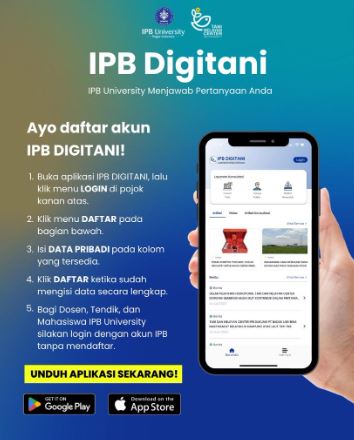
IPB University is strongly committed to improving access to food security and sustainable agriculture and aquaculture knowledge, skills, or technology for local farmers and food producers. There are several platforms and programs for local farmers and food producers, namely: DigiTani (Digital Agricultural Extension), Sekolah Peternakan Rakyat (School of Community’s Livestock), One Village One CEO, Klinik Tanaman, and training for ornamental fish producers.
1.DigiTani (Digital Agricultural Extension)
IPB launched a platform to educate farmers, DigiTani, to provide access to knowledge to farmers. Farmers can access various content provided in the IPB DigiTani application and communicate online with experts. IPB keeps improving this application to adapt to the era and the needs of farmers nowadays. IPB has the vision to be the center of information and innovation in sustainable agriculture. DigiTani is an application/online extension service IPB University provides for farmers and food producers. It involves many experts willing to share their knowledge on sustainable agriculture. The application provides information and innovations in sustainable agriculture and facilitates farmers to communicate online with experts. IPB DigiTani adapts to the era and the needs of farmers nowadays. <<see the details>>
2. Sekolah Peternakan Rakyat (School of the Community’s Livestock) Currently, IPB University has established collaborations with 26 regencies and 26 provinces in Indonesia to develop SPR and community service activities.
<<see the details>>
3. Klinik Tanaman (Plant Clinic)
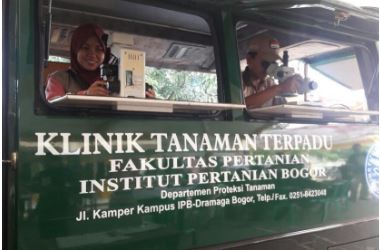
Handled by six experts on disease, pests, and Integrated Pest Management as core staff, and fully supported by students and plant protection experts at the Faculty of Agriculture, IPB. Equipped with its own operational laboratory and mobile car, as well as 10 research laboratories of the Department of Plant Protection, and other laboratories at IPB. Plant clinic services include: (1) Disease diagnosis, pest identification, plant health consultation. The techniques used range from conventional to using ELISA, and molecular biology, (2) Analysis and assessment of the health of seeds/seedlings, plants, planting media, (3) Action research and dissemination of plant pest and disease control technology, (4) Mobile plant clinic services, (5) Design and assistance of agribusiness units in the management of plant pests and diseases, (6) Quality test of biological control agents.<<see the details>>
4. Training for Farmers
- Training for Breeders. IPB University organize training for breeders to increase the readiness of female cattle on identifying productive females and improving the quality of cattle feed ready for mating by involving IPB University students in both undergraduate and postgraduate programs. <<see the details>>
- Training on Hydroponics and vermiculture. The Vocational School of IPB University organized training on hydroponics and vermiculture for farmers. <<see the details>>
- Training for Palm Oil Farmers. A total of 72 selected oil palm farmers from Morowali and North Morowali districts, Central Sulawesi, received the opportunity to increase their capacity through training with technical material for cultivating oil palm plants. The training program was held for six days, July 14–19, 2022, in Palu, Central Sulawesi. <<see the details>>
Events for local farmers and food producers
IPB provides events for local farmers and food producers to connect and transfer knowledge as follows:
- Farmer’s Day
IPB provides events for local farmers and food producers to connect and transfer knowledge. For example, IPB collaborates with Nahdlatul Ulama, an Islamic organization in Indonesia, celebrates Farmer’s Day in Klaten Regency Indonesia. This event is to strengthen the relationship between IPB University, farmers and small-medium enterprises. - Business Matching
IPB University organizes a business matching event to facilitate collaboration between tenants and investors. 28 start-up are IPB’s tenants participating in the event, and some are doing business in agriculture and food production. This event is conducted annually as part of IPB University’s commitment to growing new start-up by transferring knowledge and technical and financial assistance. - Training for Farmers
a. Training for breeders. IPB University organize training for breeders to increase the readiness of female cattle on identifying productive females and improving the quality of cattle feed ready for mating by involving IPB University students, both undergraduate and postgraduate programs.b. Training on Hydroponics and Vermiculture. Vocational School of IPB University organized training on hydroponics and vermiculture for farmers.
c. Training for Palm Oil Farmers. A total of 72 selected oil palm farmers from Morowali and North Morowali districts, Central Sulawesi, received the opportunity to increase their capacity through training with technical material for cultivating oil palm plants. The training program was held for six days, 14 – 19 July 2022, in Palu, Central Sulawesi.
University access to local farmers and food producers
IPB provides access, including facilities and consultation on technology and business management, for tenants of various types of businesses, including farmers and food producers. The facilities provided by IPB include production rooms, offices, production facilities at the Pilot Plant (evaporator, extractor, spray dryer, vacuum frying, freeze drying, packaging for retail products, etc.), product development, and laboratory services (proximate analysis and pre-clinical trials).
Access to University Facilities for Local Farmers
IPB has analytical facilities for the public to improve product quality from farmers or local businesses. Facilities at IPB for food analytical or certification:
- Food Microbiology Analysis Laboratory
- Food Biotechnology Laboratory
- Food Quality and Safety Laboratory: Chemistry
- Food Quality and Safety Laboratory: Microbiology
- Food Sensory Evaluation
- Animal Assay Laboratory
Testing Laboratory of the Department of Agricultural Industrial Technology
- Analysis for wastewater and AMDK
- Analysis of the quality of crystal sugar
- Analysis of material and agroindustry product
Testing and Certification Services Laboratory of IPB Laboratorium Jasa Pengujian dan Sertifikasi IPB
- Certified by LP-156-IDN for Analytical test
- LK-336-IDN for Calibration test,
- LSPr-030-IDN,
- LSHACCP-009-IDN,
- LSSMKP-009-IDN for product certification,
- HACCP,
- Chemical Analyses (Proximate (ash, moisture, fat, protein, carbohydrate), Dietary fiber, Vitamins (A, B1, B2, C, E), Minerals and heavy metal (Na, Ca, K, Fe, Zn, Mg, Hg, Co, Cd, Pb, Cu, As, etc), pH dan titrable acid, Fatty acid composition (GC), Sugars (total sugar, reducing and non-reducing sugar, lactose), Cholesterol (GC), Phenolic content (tanin), Formaline and borax (qualitative and quantitative), Qualitative analyses of MSG, nitrate, nitrite, and cyclamate, Beta caroten (HPLC), Amylose and amylopectin (spectrophotometer), Amino acid (HPLC), Water activity, Acidic, acetyl, ester, safonic, peroxide, and iodic values (titrimetric), Nutritional fact, Free fatty acid (titration), DHA, Cyanidic acid (qualitative/quantitative), Carageenan (Manan and alginate), MSG (qualitative), Nitrate/nitrite, Starch (Luf Schrool and Lane Eynon Methods), Pectin, Sacharine and cyclamate (qualitative), Volatile oil, Colorant (qualitative), Sulfite, Smoke test.
- Physical Analyses: Fluid behaviour (Newtonian/non-Newtonian), Rheological analyses by Farinograph, Extensograph and Brabender amylograph), Solid behavior (elasticity, plasticity, visco-elasticity, Texture analysis of food products or materials (viscosity, gel strength, crispiness), Colour (L, a, and b values), Microscopic analysis (e.g. granule size and shape), Total soluble solid, Density, Refraction index, Whiteness, Emulsion stability index, Fat impurity, Optic active, Texture Profile Analysis (hardness, brittleness, elasticity, cohesiveness, stickiness), Thermal properties (thermal conductivity), Polarized Microscopic analysis for starch granular size and shape.
- Microbial Analyses: Pathogen bacteria (Salmonella, Staphylococcus aureus, Bacillus cereus, Clostridium perfringens, Enterobacteriaceae, bacteria spore), Sanitation indicator bacteria (Coliform, E. coli, Streptococcus faecalis), Lactic acid bacteria, Yeast and mould, Total plate count (mesophyl/thermophyl), Aflatoxin B1, B2, G1, G2 (HPLC), Vibrio cholera (quantitative/aglutination), Gram positive/negative bacteria.
- Food Quality Analyses: Nutrition fact, Shelf-life determination of processed food products (Arrhenius Model and Moisture Sorption Isothermic Model), Fat quality, Sensory analysis, Determination of Fo value for thermal process adequacy (batch retort and continuous aseptic system), Other quality analyses according to client request.
Sustainable food purchases
IPB University has several market channels to market its products, and farmers, food producers, and home industries are assisted by the university. IPB prioritizes purchasing products from locals to fulfill the need of the university as well as to expand the market. To maintain the collaboration with these smallholders and SMEs, IPB keeps assisting them through technical assistance and knowledge transfer.
IPB Shop
IPB official stores are available online and offline for the campus population and the public around Bogor, Jakarta, and neighboring districts. These stores sell various products, including vegetables, meats, processed food, herbal, etc. These products are purchased from local farmers, food producers, and home industries, assisted by IPB University.
Sustainable Food Purchase From Local Farmers For IPB University Canteen
IPB University always uses local products for the canteen and meeting programs at the campus. Agricultural products marketed by the Agribusiness and Technology Park (ATP come from products of local farmers as well as ATP self-produce. More than 30 local farmers around Bogor and Cianjur collaborated with ATP IPB to produce organic foods with high quality. ATP IPB prioritizes purchasing local farmers’ products as part of IPB’s commitment to community engagement and development. Collaborating with farmers enables ATP IPB to guarantee the availability and quality of food products for sustainable marketing.
Ethical sources of food and suppliers
IPB University supports the ethical sourcing of food and supplies. This commitment is seen in policies established and enacted for use within the university ground, the immediate surrounding area, and the national scale. In 2020, IPB issued a policy highlighted the ethical sourcing of food and supplies as stated in Rector’s Decree No. 133/IT3/LK/2020 concerning IPB’s Commitment in Achieving SDGs, specifically on page 2, point J “IPB ensure ethical sourcing of food and supplies”.
SDG 2 IN NUMBER
7,400
Number of Graduates in 2022
7,400
Number of graduates from a relevant agriculture course
100 %
Percentage of graduates from agriculture
28 mt
Total Food Waste
32,983
Number of Campus Population
Select an image for which you want to see the achievement of the SDG indicators


RELATED NEWS
It seems we can’t find what you’re looking for.