SUSTAINABLE DEVELOPMENT GOALS
SDG 4: QUALITY EDUCATION
“A high-quality education should be an area where universities excel. Education is a key gateway out of inequalities, especially multi-generational ones. In addition to improving quality of life, access to inclusive education can help equip locals with the tools required to develop innovative solutions to the world’s greatest problems.”
(THE Impact Rankings)
Lifelong learning measures
Public resources (lifelong learning)
Public events (lifelong learning)
Educational Host Events (open to public)
Education outreach activities beyond campus
Lifelong learning access policy
Public resources (lifelong learning)
Free access to educational resources
IPB University is committed to providing free access to those not studying at the university’s educational resources, including free courses leading to certificates. IPB University actively organizes various seminars, webinars, summer courses, and other certified activities. During its implementation, people outside IPB who are not IPB students and become participants in seminars, webinars, summer courses, and other certified activities can access the materials and facilities provided by IPB for free. Moreover, IPB provides online courses for participants in activities involving people outside IPB via http://ocw.ipb.ac.id.
<<Open Courseware IPB University>>
Apart from that, IPB joined the Indonesia Cyber Education Institute, or what can be called the ICE Institute, which is a digital marketplace for quality online courses in Indonesia. Some of the courses that are provided by IPB University can be accessed by students from other universities in Indonesia. More information about the cooperation between IPB and ICE can be read here: IPB – Indonesia Cyber Education Institute (ICE) https://ipb.icei.ac.id.
<<Open Course IPB University at ICEI>>
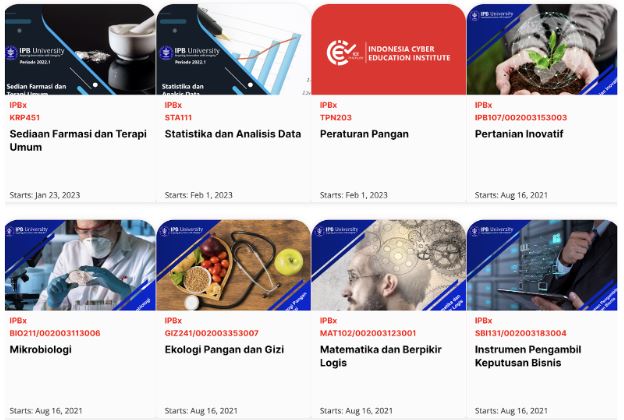
In addition, many courses at IPB University can be accessed freely through the YouTube channel IPB:
<<E-lecture Video Channel of Communication Department>>
<<E-lecture Video: Organic Chemistry>>
<<E-lecture Video: Ecological Modernization>>
IPB also provides videos containing the latest knowledge and technological developments from IPB Lectures for free on the YouTube channel. IPB TV can be accessed by people outside IPB. Short videos from IPB Talk and IPB Pedia are two of IPB’s services that can be utilized by people who are not studying at IPB so they can obtain information about science and technology developed by IPB for free.
<<Free Accessed Lecture on IPB TV>>
Free access to library and laboratory
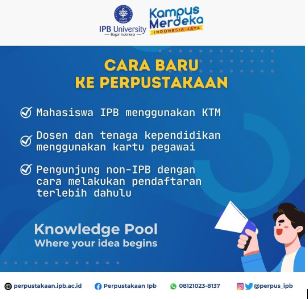
IPB University provides a library to support education, research, and community service implementation. In carrying out this function, the IPB Library collects, processes, and disseminates information on science and technology and documents the scientific works of IPB staff, theses, and dissertations. The library manages all the resources in the printed and electronic library materials. Non-IPB members also become extraordinary members by registering through the website. Non-IPB also becomes an extraordinary member by registering through the website. IPB University has more than 80 journals managed by its departments and faculties, and four of them are indexed by the reputable database Scopus. All these journals are open-access. IPB also provides free access to various knowledge products under the IPB repository.
<<see the details>>
Open access journal
IPB University has more than 80 journals managed by its departments and faculties, and four of them are indexed by the reputable database Scopus. All these journals are open-access.
<<Open Access Journal at IPB University>>
IPB also provides free access to various knowledge products under the IPB repository.
<<Repository at IPB University>>
IPB University has more than 80 journals managed by its departments and faculties, and four of them are indexed by the reputable database Scopus. All these journals are open-access. IPB also provides free access to various knowledge products under the IPB repository.
<<IPB Repository>>
Public events (lifelong learning)
IPB University hosted many events, such as seminars and webinars, public lectures, and conferences. This program varies from ad hoc to program. Many of those events were attended by many participants, not only from IPB University but also from other universities, governments, institutions, NGOs, or communities. Some events are programmed, such as Strategic Talks organized by the Directorate of Strategic Studies and Academic Reputation, which discuss public policy on agriculture, marine, and biosciences. In addition, there are also talk shows and podcast series that discuss updated research topics and transdisciplinary sciences.
- Strategic Talks: More than 1500 people participated in this program in 2022. <<see the details>>
- Green Culture Podcast: Held by The Center for Transdisciplinary and Sustainability Sciences (CTSS) at IPB University, this podcast series is themed “Co-Evolve” and encourages people to live in harmony with nature and its complexity. <<see the details>>
- IPB Talk/Podcast: Currently, more than 100 talk shows and podcasts have been aired by IPB University through its YouTube channel “IPB TV”. (IPB Talks). <<see the details>>
- Public Lecture on Sustainable Natural Resources Management by IPB University Graduate School <<see the details>>
- Public Lecture of Informatics Management Study Program and Ecotourism Study College of Vocational Studies, IPB University. <<see the details>>
- IPB Podcast. <<see the details>>
IPB also has a Tani Center, which is intended to provide agricultural information for the community, especially for farmers, breeders, and fishermen, as a community education platform. Through Digitani, farmers, livestock breeders, and fishermen can consult with IPB University experts to share insights and knowledge about agriculture, animal husbandry, and fisheries through consultations, articles, and discussion forums. It is hoped that farmers, livestock breeders, fishermen, and other practitioners can utilize the insights gained from this platform through digital agriculture, animal husbandry, and fisheries to be applied in the field.
<<Digitani>>
<<IPB Sustainability Report 2022: SDG 4>>
Educational Host Events (open to public)
IPB University holds some vocational training events for the public, seminars related to soft skill training, preparation seminars for entering the workforce, professional certification, short courses, and summer courses.
- Carrier Development and Assessment (CDA) of IPB University holds soft-skills training for career planning, soft-skills seminars, career preparation seminars, internship seminars, alumni lectures, and soft-skills training for job seekers. <<see the details>>
- IPB Training conducts several events and professional training to develop HR skills based on applied life sciences, business, economics, statistics, and so on. IPB Training delivers value through regular training services and particular training according to customer needs (in-house training). <<see the details>>
- Seafast IPB University also conducts several training to the public, such as cold chain management, better process control schools, hygiene and sanitation training, etc. <<see the details>>
- IPB University also organizes training or events that are open to the general public through the research center, such as the PKSPL (Center for the Study of Coastal and Ocean Resources) Summer Course on Tropical Sea Farming and Integrated Coastal Management.
<<see the details>> - The Faculty of Fisheries and Marine Sciences at IPB University collaborated with PT Suri Tani Pemuka to hold aquaculture training for marketing and technical service personnel. This training was held for 6 days with 59 participants. <<see the details>>
- The Department of Nutrition and Feed Technology at IPB University and the Ministry of State Secretariat held sorghum cultivation training. This training was attended by researchers from 11 countries.
<<see the details>> - Faculty of Forestry and Environment (Fahutan): IPB held the Fahutan Training Series (FTS) about “Implementing Forest Survival Techniques”.
<<see the details>>
<<IPB Sustainability Report 2022: SDG 4>>
Education outreach activities beyond campus
Regularly, IPB University organized a community services program beyond campus involving students every year (on a programmed basis) in the “Kuliah Kerja Nyata Tematik (KKNT)” (thematic community learning services). In addition, lecturers and units at IPB (Departments, Faculties, and Study Centers) carry out education outreach activities with an ad hoc and program scheme, some of which are as follows:
- Sekolah Pemerintahan Desa (School for Government’s Village Apparatus)
Since 2021, IPB University and the Bogor Regency Community and Village Empowerment Service (DPMD) have held a Village Government School (SPD). the purpose of the SPD is to build the capacity of the government’s village apparatus.<<School for Government’s Village Apparatus>>
<<School for Government’s Village Apparatus Batch 3>>
- Teaching for Society (IPB Mengajar)
Voluntary student-run schemes conducted by students, such as IPB Mengajar, one educational outreach program led by the Student Executive Board (BEM) of IPB University. - Coffe School for Society. <<see the details>>
- Thematic community services
IPB University organizes a community services program involving students every year in the “Kuliah Kerja Nyata Tematik (KKNT)” (thematic community learning services) program. In 2022, IPB sent 3531 students across Indonesia to join KKNT 2022. Students participated in community services for 40 days in 196 districts. The Institute for Research and Community Service (LPPM) at IPB University held a General Thematic Field Work Lecture (KKNT) at IPB University in 2022 to provide skills and knowledge for all participating students.
Lifelong learning access policy
IPB University has policies that guarantee open access to education without discrimination based on ethnicity, religion, disability, or gender, as stated in Rector Decree No. 133/IT3/LK/2020, p. 2, point c.
<<Rector’s Decree No. 133/2020: Commitment to Achieving SDGs>>
This policy is a derivative of Academic Senate Regulations No. 36/IT3.SA/P/2020 concerning the norms and policies of IPB University in achieving the SDGs. This regulation highlights the commitment of the university to increase access to education for the communities (Article 6, Point 4a, p. 7).
<<Senate Regulation No. 36/2020: Norms and Policy in Achieving SDGs>>
The previous regulations regarding this matter were Academic Senate Regulation No. 10/SAIPB/P/2016 concerning the academic norms of IPB University. Article 9 (point 5), p. 13, states that IPB provides open and fair opportunities for all people of the nation from various regions to become members of the academic community and educational staff at IPB.
<<Senate Academic Regulation No. 10/2016: Academic Norms of IPB University>>
SDG 4 IN NUMBER
7,400
Number of graduates
1,352
Number of graduates with teaching qualification
18.3 %
Percentage of graduates with teaching qualifications
4,293
Number of students starting 1st degree
2,824
Number of 1st gen students starting 1st degree
65.8 %
Percentage of 1st generation students
Select an image for which you want to see the achievement of the SDG indicators
RELATED NEWS
It seems we can’t find what you’re looking for.