SUSTAINABLE DEVELOPMENT GOALS
SDG 13: CLIMATE ACTION
“Climate change is a crisis that will affect every part of society, and every country. Universities need to be at the forefront of action to reduce the impact of climate change, especially amongst the poorest who will be the most affected.”
(THE Impact Rankings)
Low-carbon energy measurement
48,764 GJ
Total energy consumption
718 GJ
Electricity from low-carbon sources
1.11
Proportion of electricity from low-carbon sources
Low-carbon enrgy use
Low-carbon enrgy use
IPB University regularly measures the amount of low energy used in the whole university area. This activity is a form of IPB’s commitment to achieving the Green Campus program and reducing GHG. Our campus has more than 3 renewable energy sources. e.g., solar panels, biogas, wind, and micro-hydro.

IPB Facilities to Support Zero or Low Energy Use
- Solar Panel
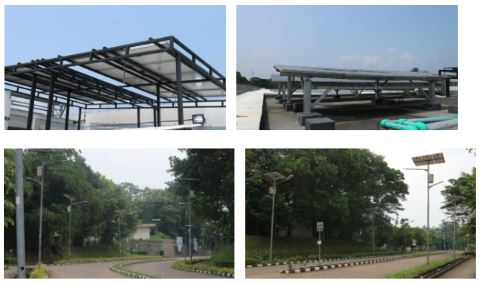
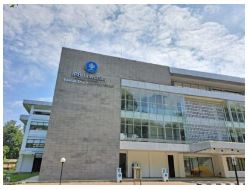
- Natural Lighting
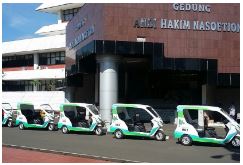
- Shuttle Bus (Bio-Solar)
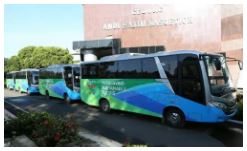
Shuttle bus helps students and staff mobility within the campus areas regularly every Monday – Friday from 6 a.m to 6 p.m. Busses are monitored via the Android/iOS app or https://bustracking.ipb.ac.id/ - Electric Car
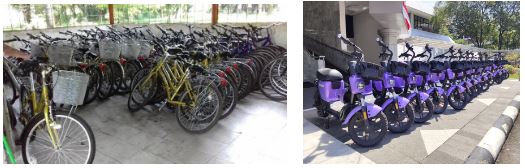
- Bike and Electric Bike
Environmental education measures
Local education programmes on climate
Climate Action Plan, shared
Co-operative planning for climate change disasters
Inform and support government
Environmental education collaborate NGO
Local education programmes on climate
IPB regularly runs climate-related educational programs and campaigns through study centers, departments, and student activities. Some examples are:
IPB School of Climate Change, Sustainability, and Disaster
IPB University organizes educational programs related to climate change issues. For example, LPPM IPB launched the School of Climate Change, Sustainability, and Disaster (Sekolah Perubahan Iklim, Sustainability, dan Bencana (PSB)). This program is expected to generate various ideas and innovations that can address climate change-related risks. This program will be held in series and present various experts.
<<see the details>>
Seminar Concerning Risk Management Climate Change-Related Disaster
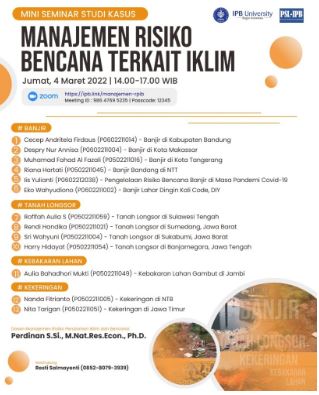
IPB University also held a mini-seminar with the theme: The Risk Management of Climate Change-Related Disasters. This mini-seminar brought up several natural disasters in Indonesia as its case studies. <<see the details>>
IPB University Students Organized a climate-responsive Village
Department of Resources and Environmental Economics IPB University students organized a Climate Responsive Village in Cibanteng Village, Bogor, West Java. The development of this climate-responsive village is carried out through community-based low-carbon activities. The students trained the community to turn waste into plant fertilizer, eco-bricks, and urban farming.
<<see the details>>
Climate Talk (series)
Climate Talk is a series of discussions with a climate theme concerning the challenges and opportunities of climate change from various perspectives, the role of technology in overcoming climate change, and the potential that can be developed in specific fields to deal with climate change. Climate Talk was organized by the Department of Geophysics and Meteorology, IPB. This event is open to the public. <<see the details>>
IPB organizes education and learning programs related to risks, impacts, mitigation, adaptation, impact reduction, and early warning of climate change
<<Sustainability Report Climate Action Plan 2022 (p. 5-10)>>
More information about education programs and climate:
<<Sustainability Learning Program 2022 (p. 11–12)>>
Climate Action Plan, shared
CCROM-SEAP IPB University Gives Technical Assistance for Development of Climate Action Plan at City Level
CCROM-SEAP (Centre for Climate Risk and Opportunity Management in Southeast Asia Pasific) IPB University provides support for the GCoM Asia Project in developing the capacity of city governments in preparing Climate Action Plans (CAP). There are 3 cities and 1 district that receive support for this activity, namely Medan City, Pontianak City, Tangerang City and North Minahasa Regency. The output of this activity is the preparation of a Regional Climate Action Plan Document which includes a GHG inventory study, a climate change risk and vulnerability study, and a climate mitigation and adaptation action plan. All of this scientific basis is packaged in a climate action plan document, which has been submitted to GCoM by the city government. <<see the details>>
Climate Resilient and Inclusive Cities Program to Help Local Governments Arrange the Climate Action Plan
CCROM-SEAP IPB University held the Climate Resilient and Inclusive Cities (CRIC) program. This program is expected to increase the capacity of local governments regarding the preparation of climate change adaptation and mitigation action plans. This activity was carried out in 10 pilot cities, namely Pekanbaru City, Pangkalpinang, Bandar Lampung, Cirebon, Banjarmasin, Samarinda, Mataram, Kupang, Gorontalo and Ternate. In its implementation, the support provided to regional governments is training and mentoring activities. The output of this activity includes (1) The City Government is able to calculate vulnerability potential impacts, (2) The City Government is able to calculate greenhouse gas, (3) The City Government can operate the SIDIK & SIGN SMART platform, (3) The City Government can identify and prioritize adaptation and mitigation action programs and activities related to climate change through the Tagging process (4) City Government in establishing a climate action plan to reduce emissions and increase adaptive capacity following national targets. <<see the details>>
Please read these articles below for further information regarding IPB University’s activities related to climate change:
<<Sustainability Report Climate Action Plan 2022>>
Co-operative planning for climate change disasters
IPB and the Ministry of Environment and Forestry Socialize SIPP-Karhutla to Maluku and Papua
The Ministry of Environment and Forestry is socializing the Forest and Forestry Prevention Patrol Information System (SIPP) to facilitate the reporting process for forest and land fire prevention patrols at the Maluku and Papua Region Climate Change Control Center (PPI). SIPP Karhutla is an application designed as an early warning and monitoring system to prevent forest and land fires. This application was designed by the Faculty of Mathematics and Natural Sciences at IPB University, together with the Ministry of Environment and Forestry.
<<see the details>>
IPB University and Ministry of Agriculture Conduct The Technical Guidance on Food Mitigation in the Face of Hydrometeorological Disasters
One of the reasons for the disruption in food stock availability is the hydrometeorological disaster. Implemented disaster management strategies frequently need to give a solution. Therefore, The Disaster Study Center of IPB University with The Ministry of Agriculture conducts online technical guidance on Availability of Food Stocks and Protection of Farmers in Sulawesi”. IPB University and The Ministry of Agriculture collaborated to create this program.
<<see the details>>
Inform and support government
IPB University Collaborates with Ministry of Environment and Forestry to Develop Early Warning System for Forest Fire
IPB University Launches Forest and Land Fire Prevention Information System (SIPP Karhutla) – SMART Patrol Information System. This SIPP Karhutla is IPB University’s breakthrough, which can solve problems with technology. This system is also part of an early warning system to predict the future in terms of efforts to prevent forest fires. The development of this system was carried out by the Computer Science Department of IPB University and in collaboration with the Sumatra Region Climate Change and Forest and Land Fire Control Center (Balai PPIKHL), the Kalimantan Region PPIKHL Center, and the Directorate of Forest and Land Fire Control – Directorate General of Climate Change Control, Ministry of Environment and Forestry (KLHK). <<see the details>>
The Center for Disaster Studies IPB University
Hydrometeorological disasters not only threaten the stability of food stocks but also threaten the survival of farmers. Therefore, studying appropriate food mitigation strategies is a frequent agenda, considering threat factors often change. The Center for Disaster Studies (PSB) IPB University has the critical task of being able to provide solutions related to disasters that impact the agricultural sector. Moreover, this sector tends to be vulnerable to disasters, especially hydrometeorological disasters, due to climate change. IPB University itself has implemented technology 4.0 to help farmers predict disasters and provide appropriate mitigation steps so that PSB IPB can work together with local and regional governments to help predict and develop disaster mitigation plans. <<see the details>>
Environmental education collaborate NGO
IPB University Collaborated with Islamic Series Indonesia conducted the study “Gender-Based Approach to Climate Change Adaptation in Lombok”
Department of Consumer and Family Sciences, Faculty of Human Ecology, IPB University, in collaboration with Islamic Relief Indonesia, conducted the study “Gender-Based Approach to Climate Change Adaptation in Lombok”. This study aims to assess the extent to which women are vulnerable to climate change disasters on Lombok Island. This study also identifies the process of mainstreaming gender issues in development planning. As well as identifying gender-based good practices according to the results of evaluation and learning during the project.
<<Gender-Based Approach to Climate Change Adaptation in Lombok>>
IPB Collaborated with Global Green Growth Institute to Develop an Integrated Strategic Instrument for Supporting The Integration of NDCs into Development Plans and Policies
CCROM SEAP IPB, in collaboration with the Global Green Growth Institute, is carrying out integrated strategic instrument development activities to support the integration of Nationally Determined Contributions (NDC) into the Indonesian government’s development plans and policies, starting September 2021 to March 2023. This activity aims to prepare an integrated strategic instrument to support the Indonesian government in mainstreaming it. NDC into development plans and policies and to invest in reducing emissions from deforestation, forest degradation, and peatlands through strengthening government and stakeholder capacity. <<see the details>>
Faculty of Forestry and Environment IPB University Collaborated With FIELD Indonesia Held Clean Air Program
IPB University’s Faculty of Forestry and Environment collaborates with FIELD Indonesia to hold a collaborative program to create clean air. Some of the main activities are related to controlling forest and land fires. Apart from that, this program also helps facilitate Burn-Free Land Preparation (PLTB) Training activities, which are coordinated directly by FIELD Indonesia. The training is held where forest or land fires frequently occur. <<see the details>>
IPB Collaborated With ISBB Held International Conference About “Sawit Baik”
IPB University’s Surfactant and Bioenergy Research Center (SBRC), in collaboration with the International Society of Biomass and Bioenergy (ISBB), held the 2022 International Conference on Biomass and Bioenergy (ICBB). This international conference is one of the forums to promote and campaign for “Sawit Baik” internationally. Utilizing biomass into bioenergy can increase national bioenergy use and support the government in reducing greenhouse gas emissions and meeting Net Zero Emissions (NZE) targets.
Other activities carried out by IPB in collaboration with the Lentera Pustaka Community Reading Park
<<Sustainability Report Climate Action Plan 2022.pdf (p. 10)>>
Commitment to carbon neutral university
Commitment to carbon neutral university
Commitment to carbon neutral university
IPB University signed the policy and set the goal to become carbon neutral by 2030. This is stated in the Rector’s Decree No. 298/IT3/LK/2020 concerning the Commitment of IPB University in Achieving Carbon neutrality in 2030. This commitment has been reflected through various campus operational activities:
- limiting energy usage and emissions from transportation
- obtaining electricity and other forms of energy from zero or low carbon energy sources
- taking the initiative and leading the way towards climate-neutral food production and consumption
- green infrastructure and buildings
- integrated and sustainable waste management, efficient water usage & conservation program.
In addition, IPB measured carbon emissions using a standardized method, and the report is available at the following link:
- IPB Carbon Footprint Study
- IPB Energy and Transportation Sector Emissions Trend
- Carbon Footprint Simulation with baseline
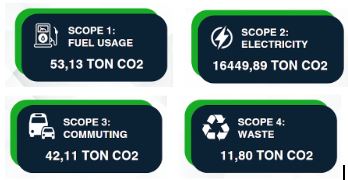
IPB University conducted the carbon footprint calculation on the Dramaga Campus, including Scope 1 of Fuel Usage, Scope 2 of Electricity, Scope 3 of Travel and Commuting, and Scope 4 of Waste. <<see the details>>
Select an image for which you want to see the achievement of the SDG indicators
RELATED NEWS
It seems we can’t find what you’re looking for.